We have all experienced that specific kind of exhaustion where, despite sleeping for eight hours, we wake up feeling heavy. It’s a fatigue that lives in the mind rather than the muscles—a result of constant decision-making, digital noise, and the pressure to always be “on.”
When we reach this point, we are often told to “just rest.” But sometimes, passive rest isn’t enough. When our nervous system is overstimulated, sitting in silence can feel agitating rather than calming. This is where the concept of slow self-care comes in.
Instead of escaping our lives, we can engage in creative self-care activities that require just enough focus to quiet the noise, but not enough to add to our “performance” anxiety. It’s about doing rather than fleeing. It’s about using our hands to anchor our minds.

Why Creativity Helps the Nervous System Slow Down
Our nervous system thrives on rhythm and predictability. When we are stressed, our “fight or flight” response is active. To move back into a state of “rest and digest,” we need signals of safety.
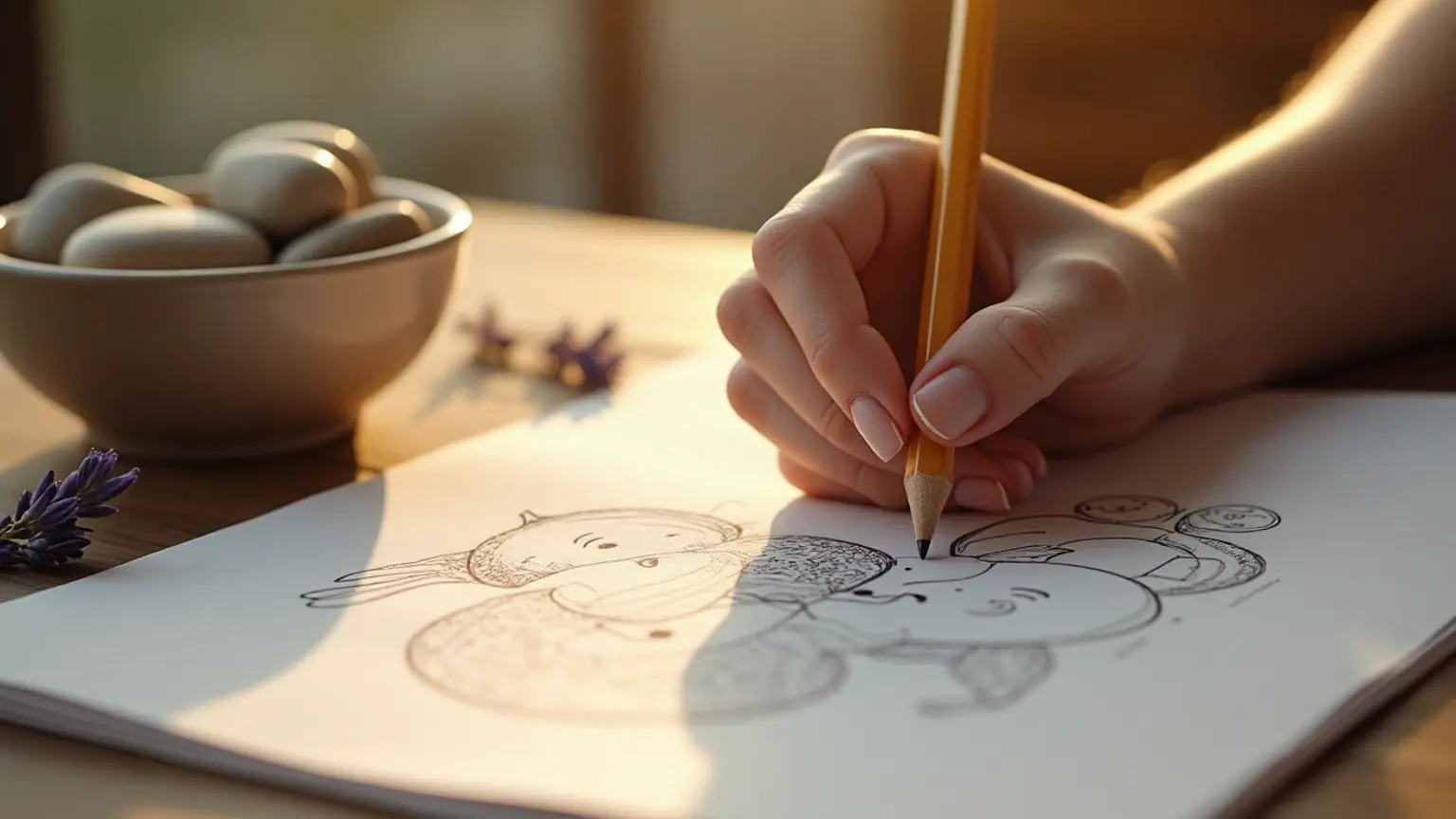
Creative gestures—the rhythmic stroke of a colored pencil, the repetitive movement of a pen across a page, or the tactile sensation of tearing paper for a collage—act as physical anchors. These mindful activities for women provide a “soft focus.” Unlike the “hard focus” required for work or problem-solving, soft focus allows your brain to idle while your hands stay busy.
This sensory engagement tells your brain that you are safe in this moment. There is no threat to outrun, only a line to draw or a thought to witness. By focusing on the “here and now” through a creative medium, you allow your heart rate to slow and your breath to deepen naturally.
What Makes a Self-Care Activity “Creative”?
It is a common misconception that you must produce “art” for an activity to be creative. In the context of gentle self-care ideas, creativity isn’t about the final product; it’s about the intention.
An activity becomes a form of creative self-care when it possesses three qualities:
- Intention: You are doing it for yourself, not for an audience.
- Freedom: There is no “wrong” way to do it. You are free to change colors, ignore lines, or stop halfway through.
- Absence of Judgment: You silence the inner critic that asks, “Is this good?” and replace it with the observer that asks, “How does this feel?”
When you remove the pressure of performance, creativity becomes a sanctuary. It is slow creativity at its finest: no talent required, just the page and you.
8 Gentle Creative Self-Care Activities to Try Today
If you are feeling overwhelmed, don’t try to do all of these. Simply look through this list of creative self-care activities and see which one feels like a “yes” in your body.
1. Slow Journaling
Instead of recording what happened in your day, focus on the physical act of writing. Use a pen you love. Focus on the curves of the letters. Write one sentence, then take a breath. Write another. Let the ink be a slow trail of your presence.
2. Mindful Coloring
Choose one color that represents “calm” to you. Fill a small area of a page with that color. Don’t worry about completing a whole picture; focus on the sensation of the pigment meeting the paper.
3. Intuitive Collage
Find a magazine or an old book. Without thinking too much, tear out three images or colors that catch your eye. Glue them onto a blank page. The act of tearing and sticking is a wonderful way to process unexpressed emotions.
4. Writing Fragments
Sometimes, a full paragraph is too much. Try “fragment writing.” List five things you can smell, or three textures you touched today. Fragments are low-pressure ways to reclaim your narrative.
5. Gentle Sketching (Tracing Lines)
You don’t need to draw a subject. Simply trace the outlines of a leaf, your own hand, or the shadows on your desk. This “following of the line” is a powerful grounding technique.
6. Memory Mapping
Draw a simple map of a place where you felt safe—a childhood bedroom, a favorite park, or a dream vacation. Don’t worry about accuracy; focus on the feeling of that space as you map it out.
7. Color Palettes of the Soul
Pick three colored pencils. Use them to create small “swatches” of how you feel in this exact moment. Name the colors if you wish (e.g., “Quiet Morning Blue” or “Dusty Rose Resilience”).
8. Word Collecting
Open a book to a random page. Find three words that feel “soft” or “strong.” Write them down in your activity book. Give them space to breathe on the page.
How to Choose an Activity Without Overwhelming Yourself
The irony of self-care is that having too many options can cause more stress. To keep these mindful activities for women effective, follow the rule of “The Power of One.”
Choose one activity. Give yourself five minutes. If you want to stop after five minutes, stop. The goal isn’t to finish a page; the goal is to experience the “creative pause.”
By giving yourself the permission to stop, you remove the “to-do list” energy from the activity. It remains a gift, not a chore.
Why Slowness Is a Feminine Resource
In our “hustle” culture, slowness is often equated with weakness or laziness. But in the realm of feminine empowerment, slowness is a position of strength.
Slowness allows for listening. When we move too fast, we lose the ability to hear our own intuition. By choosing slow self-care, you are reclaiming your own rhythm. You are deciding that your internal pace is more important than the external world’s demands. This is an act of rebellion against a world that wants you to be a machine.
Slowness is how we nourish our sensitivity. It is how we stay “soft and strong” at the same time.

Letting Go of “Productive” Self-Care
We need to decondition ourselves from the idea that self-care must have a “result.” You don’t need to “show” your activity book to anyone, post it on social media, or even look at it again if you don’t want to.
The value is in the being, not the producing.
When we move away from “productive” wellness, we enter a space of true healing. We are no longer trying to “fix” our fatigue; we are simply allowing ourselves to exist within it, supported by the gentle structure of a creative task.
Reflection: The Deeper Breath
Take a moment to close your eyes and check in with your body.
Which creative activity—whether it was coloring, writing fragments, or simply tracing a line—helps you breathe deeper just by thinking about it?
In our book, “52 Marilyn Moments,” many of the pages are specifically designed for these moments when slowing down feels like a necessity, not an indulgence. They are “paper sanctuaries” waiting for you to enter, with no expectations and no deadlines.
Reclaim Your Rhythm
You are allowed to take up space, and you are allowed to take your time.