
In our hyper-digital age, we are constantly consuming. We swipe, we scroll, and we “receive” information from screens until our minds feel saturated and our eyes feel tired. Many of us find ourselves yearning for something tangible—a way to slow down that doesn’t involve another app or a complex new hobby.
This collective burnout is exactly why so many women are returning to a format once reserved for childhood: the activity book.
However, an activity book for adults is not just a collection of puzzles or simple drawings. It is a sophisticated tool for creative self-care. It is a dedicated space where reflection, presence, and play intersect. If you have been looking for a way to quiet the mental noise and reconnect with your inner voice, understanding this hybrid world might be the first step on your journey.

Why Adults Are Returning to Creative Play
The modern world demands constant optimization. We are told to “hustle,” to be productive, and to turn our hobbies into “side quests.” Consequently, our brains are in a state of chronic high-alert. This mental fatigue has created a deep hunger for “low-stakes” activities—things we do purely for the sake of doing them, with no audience and no performance pressure.
Returning to a physical book offers a sensory “landing strip” for a scattered mind. The texture of the paper, the scent of the ink, and the rhythmic motion of a pen or pencil provide a grounding experience that a screen simply cannot replicate. We aren’t just “playing”; we are engaging in a form of slow creativity that allows our nervous system to reset.
Defining the Activity Book for Adults
So, what exactly makes this different from a children’s book or a standard journal?
An activity book for adults is a hybrid. It is more structured than a blank notebook but more flexible than a textbook.
- It is not a children’s book: The themes are mature, focusing on identity, history, and emotional depth.
- It is not a traditional journal: While it includes writing prompts, it also offers visual tasks like coloring or collage to engage the “right brain.”
- It is not a rigid workbook: There are no “right” answers and no grades. It is a companion, not a teacher.
In essence, it is a curated experience designed to move you through different states of mind—from the focus of coloring to the introspection of a deep journaling prompt.

How Activity Books Support Creative Self-Care
We often think of self-care as something passive, like taking a bath or a nap. While those are valuable, creative self-care is active. It involves the “flow state”—that magical moment where you lose track of time because you are completely absorbed in a gentle task.
Activity books for adults facilitate this state by removing the “fear of the blank page.”
- Creativity Without Performance: Since the page is already partially filled with prompts or illustrations, the pressure to be an “artist” disappears. You are invited to play, not to produce.
- Sensory Engagement: The physical act of coloring or tracing lines acts as a “bottom-up” regulation for the brain, calming the body first so the mind can follow.
- Gentle Presence: Each activity acts as an anchor, keeping your attention in the “here and now.”
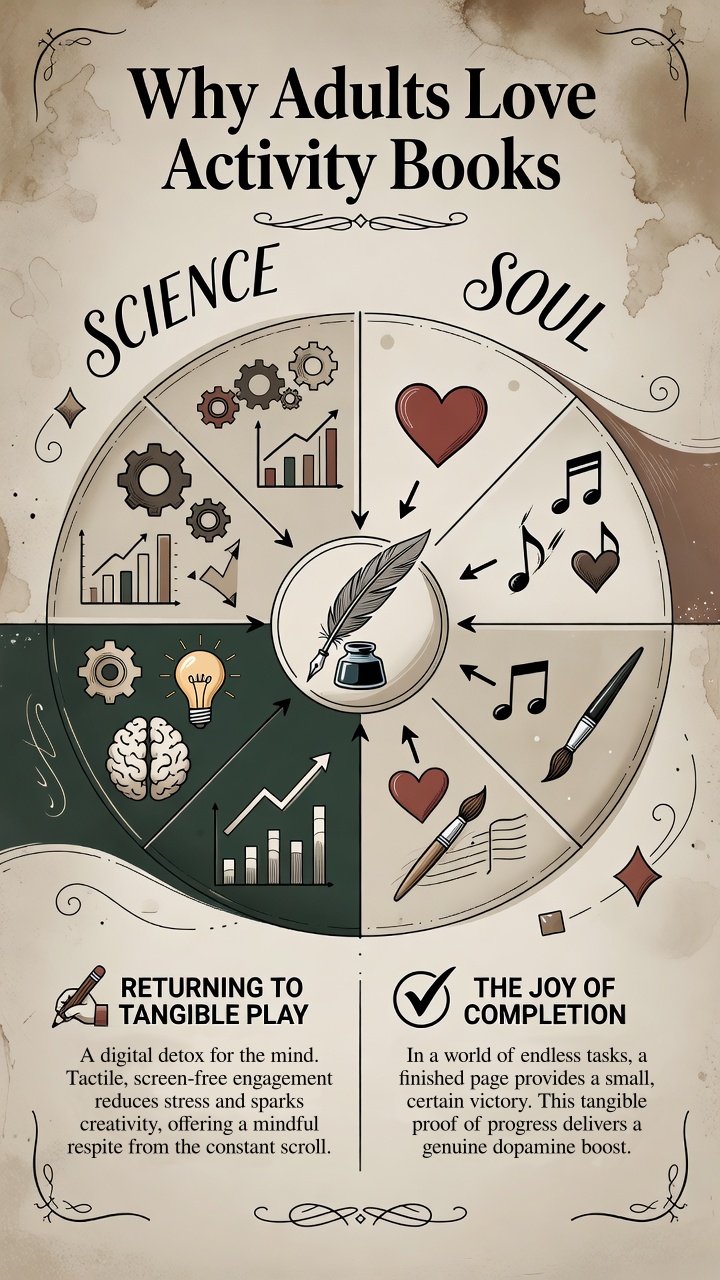
Mindful Activities for Adults: What’s Inside?
If you are new to this format, you might wonder what you actually do in these books. The magic lies in the variety. A well-designed activity book for adults offers a “buffet” of activity book ideas that cater to different energy levels:
- Journaling Prompts: These aren’t “Dear Diary” entries. They are targeted questions that help you explore your identity, your history, and your dreams through a new lens.
- Mindful Coloring: This isn’t about staying inside the lines. It’s about the rhythmic, meditative motion of color on paper to lower stress.
- Creative Challenges: Small, low-pressure tasks like “collecting words” or “tracing a feeling” that bypass your inner critic.
- Reflection Exercises: Activities that invite you to look at an image or a quote and see where it resonates within your own life.
- Tactile Play: Collage, list-making, or even “messy” sketching that encourages you to let go of perfectionism.
Why “Doing” Feels Different Than “Reading”
Many of us love to read biographies or self-help books. However, reading is a receptive act—you are taking in someone else’s thoughts. “Doing” an activity is an act of incarnation.
When you pick up a pen and interact with a prompt, you are no longer just a spectator of a story; you are part of the narrative. This physical engagement creates a stronger “emotional memory.” You aren’t just learning about a concept like resilience or softness; you are practicing it through the act of creation. In other words, the book becomes a mirror rather than a window.
Who Is This Creative Format For?
One of the most common myths is that you need to be “creative” or “artistic” to use an activity book for adults. In reality, these books are designed for the person who feels they have lost their creative spark.
It is perfect for:
- Sensitive Women: Who need a quiet, aesthetic sanctuary to process their world.
- Creative Spirits: Who feel “blocked” and need a low-pressure way to start making marks again.
- Women in Transition: Who are looking for a way to ground themselves during a change in career, relationship, or life stage.
It might not be for you if:
- You are looking for a rigid, academic course with specific learning outcomes.
- You prefer purely digital experiences and dislike the “mess” of paper and pencils.

Turning the Activity Book into a Gentle Ritual
The beauty of the activity book for adults is that it doesn’t ask for much. You don’t need a studio or three hours of uninterrupted time. You only need five minutes and a pen.
By integrating these mindful activities for adults into your daily life, you create a “gentle ritual.”
- It could be five minutes with your morning coffee.
- It could be a way to “wash off the day” before bed.
- It could be a companion for a quiet afternoon in a café.
When you make time to create, even in small increments, you are sending a powerful signal to yourself: “My presence matters. My peace is worth protecting.”

Reflection: Your First Step into Play
Before you look for the “perfect” book, take a moment to check in with yourself.
What kind of activity helps you feel present without trying to improve yourself or “get it right”?
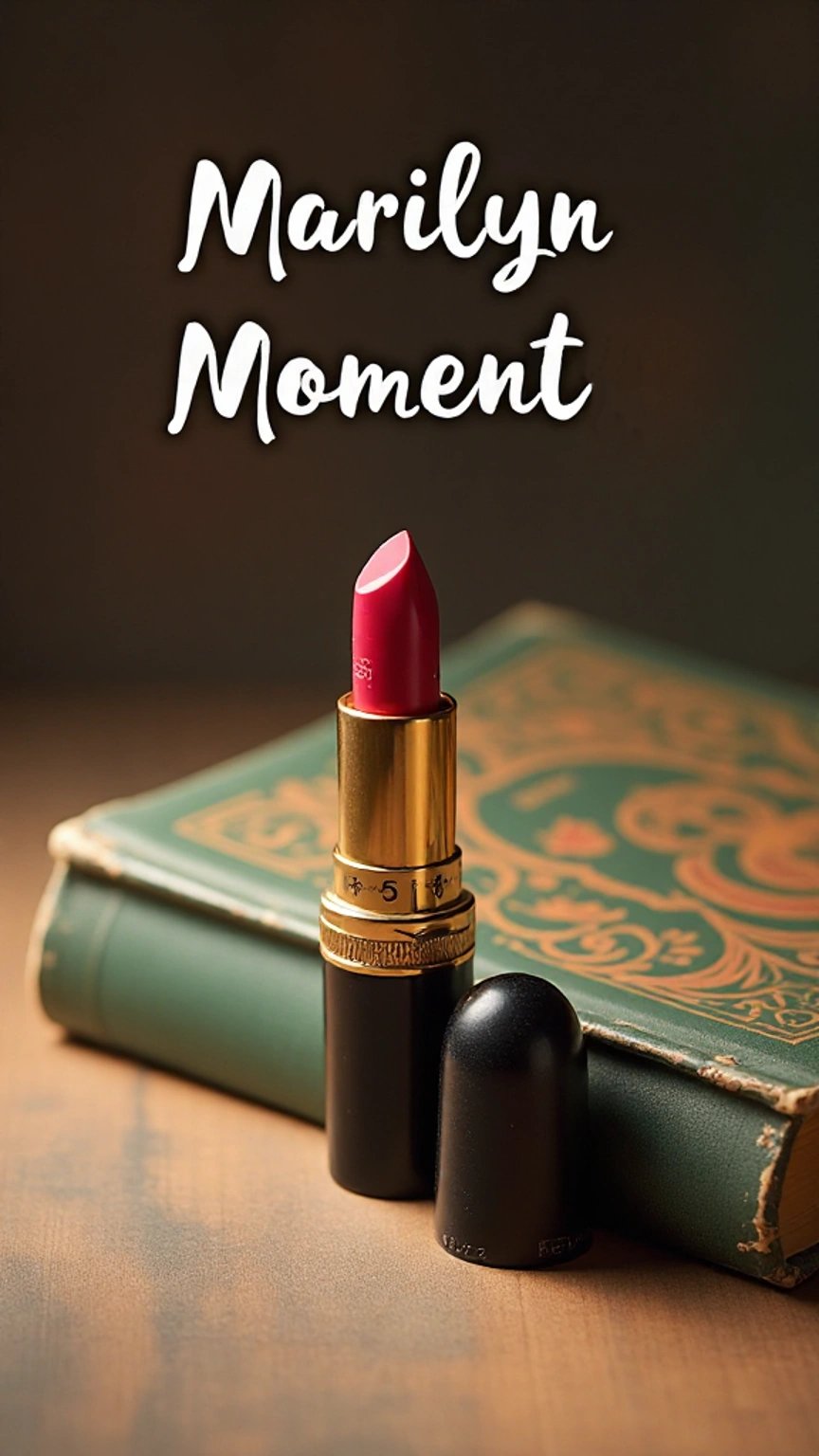
In creating “52 Marilyn Moments,” I wanted to build more than just a book. I wanted to design a Marilyn-inspired activity book that felt like a conversation with an icon—and a conversation with yourself. It is a space designed for softness, where you can explore identity and creativity at your own pace, one page at a time.
Ready to Start Your Journey?
If you’re curious about how to begin your own practice of creative self-care, explore our guide on The 5 Tools You Need for Your Activity Book or see how Marilyn’s life can inspire your own creative reflections.